 Skip-the-line available
 Caserta vs Versailles — Which Royal Palace Should You Visit?
Bigger floor area, a century younger, a quieter visit — an honest comparison of the two great Bourbon palaces.
Every visitor approaches Reggia di Caserta with the same instinctive comparison ready: it is, the guidebooks say, the 'Versailles of the South'. The label is fair but slippery. Caserta is not a copy of Versailles — it is the Bourbon answer to Versailles, commissioned a century later by a king who wanted what Louis XIV had built and felt he could exceed. In some respects he did. The palace is larger in floor area; the axial garden runs three kilometres rather than three hundred metres of central perspective; the surrounding park is supplied by an aqueduct of engineering ambition that has no peer at Versailles. In other respects he did not. Versailles is the older, the more politically consequential, the more densely art-historical building. This guide compares the two honestly, so you can choose between them when an itinerary forces the choice.
Scale and Floor Area — Caserta is the Larger Palace
By gross floor area, the Reggia di Caserta is the larger of the two palaces. The 18th-century inventory records around 1,200 rooms across five floors, organised around four monumental internal courtyards. Versailles, even counting the wings, the Trianons and the dependencies, has a smaller central palace footprint, although its total estate including the gardens and park is geographically larger. The point is not which is the bigger tourist site overall — it is that Caserta's main block of building, the slab of travertine and brick you see from the forecourt, is a single architectural object larger than Versailles' principal palace. For visitors arriving expecting a smaller or lesser building, the first sight is corrective.
What this scale means in practice is fewer crowds per square metre. The Royal Apartments at Caserta unfold across distances that feel almost industrial — the Hall of the Halberdiers leads into the Throne Room which leads into the King's Apartments along an enfilade that takes minutes to traverse at a brisk walk. Versailles compresses its great rooms more tightly, which is part of why its visitor density feels so much higher. The Hall of Mirrors at Versailles is a famously crowded room; the equivalent ceremonial sequence at Caserta, the Throne Room and its approach, is rarely shoulder-to-shoulder.
Age, History and the Bourbon Ambition
Versailles is the older palace by roughly a century. Louis XIV transformed his father's hunting lodge into the seat of the French court through the 1660s, 1670s and 1680s, and the building reached its mature form well before 1700. Caserta was commissioned by Charles VII of Bourbon — later Charles III of Spain — in 1750, the foundation stone laid in 1752, with Luigi Vanvitelli as architect. Construction continued under Charles's son Ferdinand IV and was substantially complete by 1780, though decorative work continued into the 1840s. Caserta is therefore a late Baroque and early Neoclassical building, where Versailles is a high Baroque one.
The Bourbons were explicit about their model. Charles wanted a palace that would announce the new Bourbon kingdom of Naples as a European power on a level with France, and instructed Vanvitelli to study Versailles and the Spanish royal palaces and to produce something that would not be eclipsed by them. Vanvitelli's answer was to take the French axial-garden idea and amplify it — to push the central perspective so far that the cascade vanishes into the foothills of Monte Tifata, three kilometres from the palace. Where Le Nôtre at Versailles framed his axis around the Grand Canal, Vanvitelli framed his around running water descending the natural slope.
Politically, Versailles outweighs Caserta. The French court at Versailles was the centre of European court culture for nearly a century; the Bourbon court at Caserta was provincial by comparison, and the palace was only intermittently a royal residence after Italian unification. The 20th century reduced Caserta further to a series of administrative and military uses before its restoration as a museum, while Versailles has been a national museum since 1837. The two buildings carry very different historical weight, even if their architectural ambition is comparable.
Gardens — Two Different Philosophies
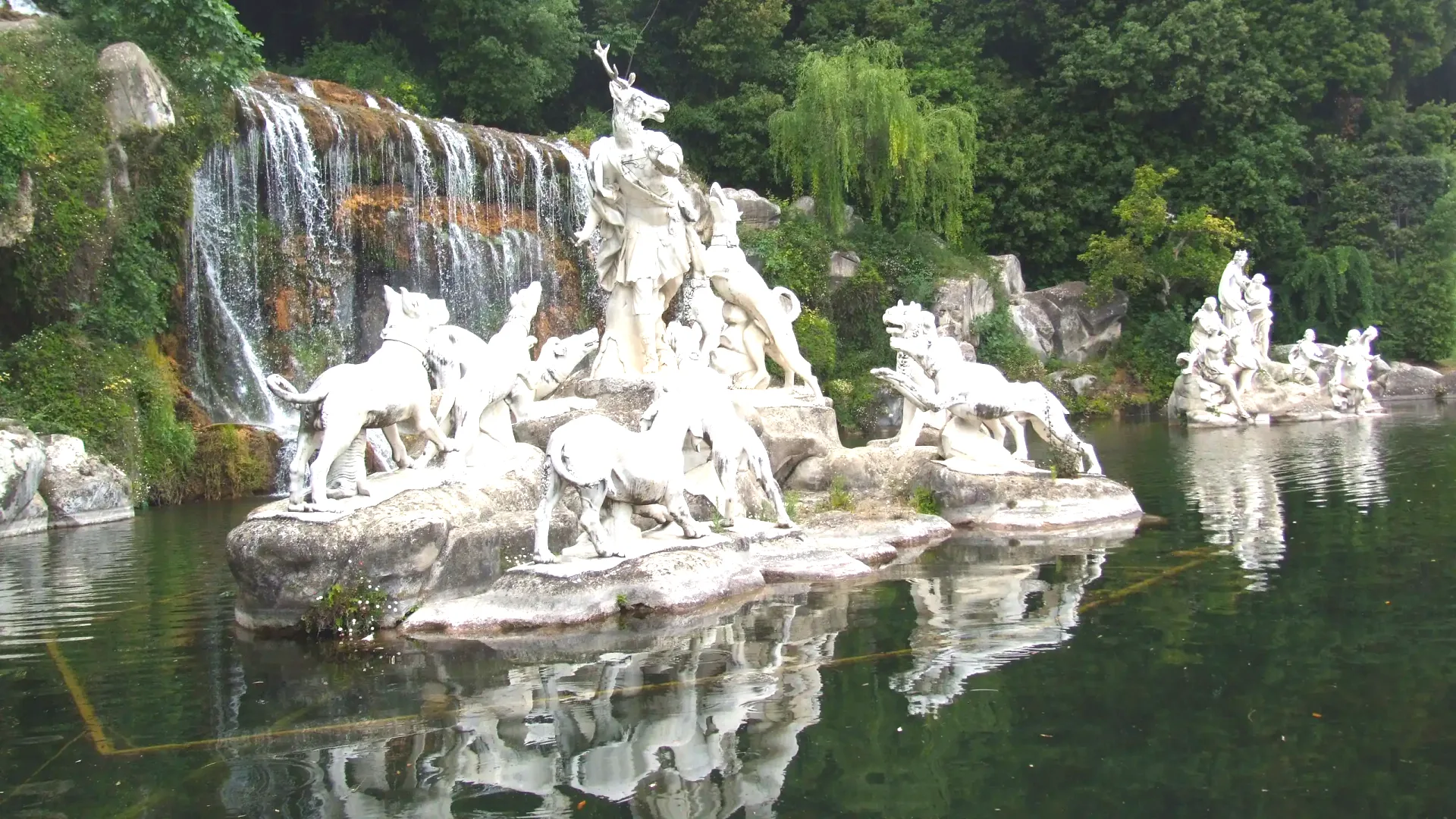
Versailles' gardens are pure André Le Nôtre French formal: parterres, bosquets, the great cross-axis of the Grand Canal, sculpture lining every avenue, water playing in geometric basins. The hand of the gardener is everywhere visible; nature is subjugated to perspective. Caserta's gardens are bipartite. The first two kilometres of the central axis follow the Italian-French formal tradition Vanvitelli adapted from Versailles: a sequence of fountains descending toward the cascade. The final kilometre, the upper terraces around Diana e Atteone, transitions into something steeper and more rugged, where the architecture begins to give way to landscape.
Then, branching off to the east, the English Garden — commissioned by Queen Maria Carolina in 1782 and designed by Sir John Graefer with advice from Sir William Hamilton — breaks the French model entirely. This is a romantic landscape garden in the English tradition, with deliberately picturesque ruins (built to look ancient), a grotto, exotic plantings including some of the first camellias grown in continental Europe, and winding paths that conceal rather than reveal. Versailles has nothing of this kind on the same scale. The Trianon estate and Marie Antoinette's hameau approach the picturesque, but the English Garden at Caserta is a more thoroughgoing essay in the style.
The cascade is the defining difference. Versailles' water features depend on a vast and expensive pumping system that historically ran only on certain days for the king's pleasure. Caserta's cascade descends by gravity from the Carolino Aqueduct, an engineering project Vanvitelli designed to bring water from the Monte Taburno springs forty kilometres away. When the cascade is running, the sound carries across the upper terraces in a way no Versailles fountain matches.
Royal Apartments — Different Eras, Different Tastes
Versailles' apartments are predominantly late 17th-century in their design and early 18th-century in their decoration, with successive Louis XV and Louis XVI overlays in specific rooms. The Hall of Mirrors, the King's State Apartments, the Queen's Apartments and the Royal Chapel are the canonical sequence. Caserta's apartments are later — late 18th-century Neoclassical with substantial early 19th-century redecoration under Murat and the restored Bourbons. The aesthetic is less ornate than Versailles' Baroque, leaning into clean classical proportion, painted ceilings in the manner of Mengs and Conca, and rich but disciplined gilding.
Specific highlights at Caserta with no Versailles equivalent include the Court Theatre (Teatro di Corte), an exquisite small horseshoe theatre completed in 1769 and a direct model for La Scala in Milan; the Picture Gallery; and the spectacular Scalone d'Onore, the grand staircase Vanvitelli designed as the formal arrival sequence. Versailles' equivalent grand approach is the Ambassadors' Staircase, which was demolished in 1752 — by an unhappy coincidence, the same year Vanvitelli broke ground at Caserta. Versailles' standout features without a Caserta peer include the Hall of Mirrors itself, the Royal Chapel as a piece of integrated architecture, and the dense historical art collection in the Galerie des Batailles.
Which to Choose — A Concierge's Honest View
If you can visit only one in your lifetime, and you have no particular preference between Italy and France as travel destinations, choose Versailles. The historical weight, the density of the art and decoration, the integration with the wider Versailles town and the Trianons, and the simple fact that it sits inside one of the world's most-visited cities make it the more complete art-historical experience. If you have already seen Versailles, or you are travelling in Italy and the choice is Caserta versus another half-day site, choose Caserta without hesitation. It is the larger, the less crowded, the more architecturally surprising of the two, and it offers an experience — the three-kilometre axial cascade, the English Garden, the Court Theatre — that Versailles cannot match.
If you are travelling with children, Caserta wins outright. The park is bigger, the bicycle hire makes it navigable, the cascade is a genuine kid-magnet, and the crowd density is gentler. If you are a photographer, Caserta wins for the long axial shots and for crowd-free interior compositions; Versailles wins for the dense Baroque set-pieces and the integration with the wider French landscape. If you are an art historian, Versailles. If you are an engineering historian or a garden historian, Caserta. The two palaces are not substitutes for each other — they are sibling answers to the same 18th-century European question about what a Bourbon royal residence should be, and seeing both is a richer experience than seeing either alone.
Frequently asked
Is Caserta really bigger than Versailles?
By gross floor area of the principal palace building, yes — Caserta records around 1,200 rooms across five floors, larger than the central palace at Versailles even with its wings. By total estate area including gardens and outlying buildings, Versailles is comparable or larger. The honest summary is that Caserta is the larger single architectural object, and Versailles is the larger overall complex.
Did the Bourbons copy Versailles when they built Caserta?
Charles VII of Bourbon explicitly instructed his architect Luigi Vanvitelli to study Versailles and the Spanish royal palaces and to produce something that would rival them. Caserta is not a copy of Versailles — it is a Bourbon response to it, drawing on the same axial-garden idea but amplifying the scale, adding the gravity-fed cascade, and adopting a later Neoclassical interior aesthetic. The comparison was deliberate from the beginning.
Which palace has the better gardens?
It depends on which tradition you prefer. Versailles offers the most complete realisation of Le Nôtre's French formal garden, with the Grand Canal and the parterres as set-pieces. Caserta offers a longer axial run, a gravity-fed cascade Versailles cannot match, and the English Garden — a thoroughgoing romantic landscape garden that Versailles' Trianon estate only partly equals. For pure French formal: Versailles. For variety and engineering ambition: Caserta.
Is Caserta less crowded than Versailles?
Significantly less. Versailles receives several million more annual visitors than Caserta, and its central palace is denser in floor plan, which concentrates crowds in famous rooms like the Hall of Mirrors. Caserta's apartments are rarely shoulder-to-shoulder even on busy days, and the three-kilometre park disperses garden crowds quickly. Even on Italian holidays such as Pasquetta and Ferragosto, the Caserta interior remains comfortable.
Which palace is older?
Versailles is older by roughly a century. Louis XIV transformed his father's hunting lodge into the seat of the French court through the 1660s to 1680s. Caserta was commissioned in 1750, the foundation stone laid in 1752, and the building was substantially complete by 1780, with decorative work continuing into the 1840s.
Does Caserta have anything Versailles doesn't?
Yes. The Court Theatre (Teatro di Corte), a small horseshoe theatre completed in 1769 that served as a direct model for La Scala in Milan, has no Versailles equivalent. The Carolino Aqueduct and the three-kilometre gravity-fed cascade are an engineering project beyond anything at Versailles. The English Garden at Caserta is a more thoroughgoing realisation of the romantic landscape style than anything in the Versailles estate.
Which one is better for children?
Caserta. The park is bigger, navigable by bicycle hire inside the gates, and the cascade is a genuine attraction for kids who love running between the fountains. The English Garden's deliberately picturesque ruins and grotto have a fairy-tale quality. The Royal Apartments are walkable without queue-shuffling, which matters with under-tens. Versailles is intellectually richer but logistically harder for young children.
Should I do Caserta as well as Versailles, or just one?
If you are travelling in Italy and have a half-day to a full day available, do Caserta — it is its own experience, not a substitute. If you are choosing between the two as a single lifetime visit and have no other preference, do Versailles for the historical weight and the density of art. Seeing both, ideally on separate trips, is a richer comparative experience than seeing either alone.
Was Caserta used as a film location like Versailles?
Yes. The Royal Apartments at Caserta stood in for the palace of Naboo in Star Wars Episode I (The Phantom Menace) and Episode II (Attack of the Clones), and the Reggia has hosted scenes in Mission: Impossible III, Angels and Demons and other major productions. Versailles has its own filmography. For Star Wars fans specifically, Caserta is the more rewarding visit.