 Skip-the-line available
 The Best Time to Visit the Reggia di Caserta
When the cascades run, when the crowds thin, and when the palace's east facade catches the light just so.
Choosing when to visit the Reggia di Caserta is, more than at most Italian monuments, a decision about water. The three-kilometre axial cascade that defines the park — the feature that makes a photograph of Caserta instantly recognisable — runs only on a published schedule, and only across the warmer half of the year. Add to that the cadence of Italian school holidays, the August Ferragosto exodus from Naples, the Easter Monday Pasquetta tradition of picnicking in royal parks, and the simple fact that the palace closes every Monday, and the question of 'when' becomes the question that shapes everything else about a Caserta day. This guide walks through the calendar month by month so you can pick a date where the fountains play, the light is generous, and the crowds remain manageable.
The Cascade Water Schedule — Why It Dictates Your Visit
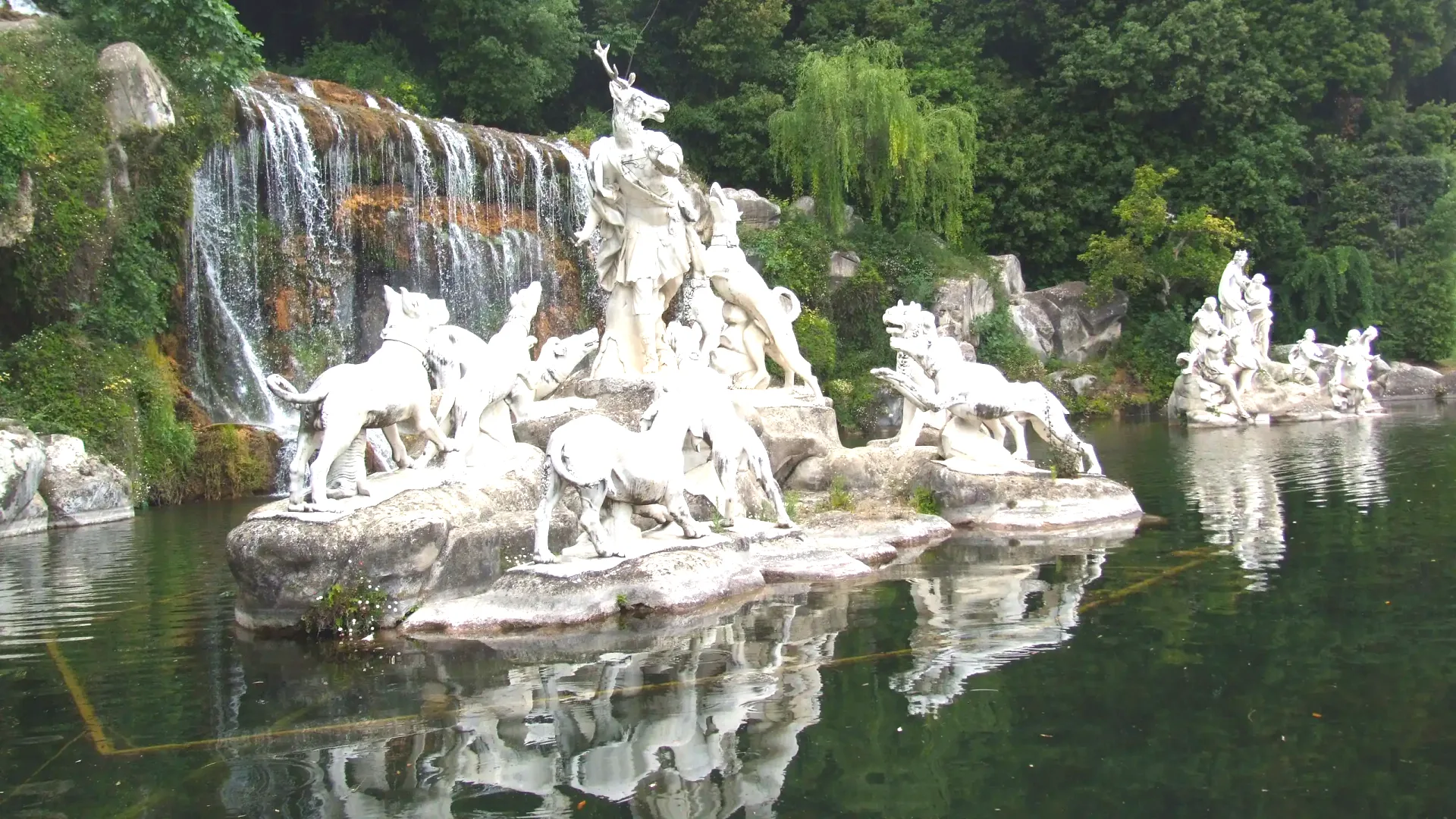
The axial cascade at the Reggia di Caserta is not a continuous waterfall. The Carolino Aqueduct, built by Luigi Vanvitelli to feed the basins, has limited throughput, and the Ministry of Culture publishes the fountain operating calendar each season. As a general rule, the cascade and its sequence of fountains — Margherita, Eolo, Cerere, Venere e Adone, and the climactic Diana e Atteone — run from spring through late autumn, typically Tuesday through Sunday, broadly between mid-morning and late afternoon. Winter visits will find dry basins. Monday closures of the palace also coincide with the fountains being off. The official schedule shifts year to year by a few weeks at either end, so check reggiadicaserta.cultura.gov.it within the fortnight before you travel. Arriving when the cascade is dry is the single most common Caserta regret, and it is entirely avoidable.
Within a fountain-on day, the water does not run continuously down the whole 3-kilometre run. Each basin has its own jets and timed displays, and the upper Diana e Atteone cascade is the most reliably active throughout opening hours. The lower basins — those closer to the palace — may pulse rather than gush. Photographers chasing the long perspective shot, with the palace shrunk to a pale block at the far end of the water-mirror, will want late morning, when sun is still on the cascade rather than behind it. If you only have time for one basin, walk or cycle the full axis to Diana e Atteone; the bas-relief sculptures of Diana surprising Actaeon are the masterpiece the whole garden was designed to reach.
The cascade does not run on certain Italian state holidays even within season, and unscheduled maintenance can suppress the display without notice. The two practical mitigations are to email the palace ticket office a week ahead asking for confirmation, and to schedule your visit for a Tuesday, Wednesday, Thursday or Friday in May, June, September or October — the sweet spot where the water is most reliably flowing and the crowds least dense.
Month-by-Month — What Each Season Brings
January and February are quiet, cold, and the fountains are off. The Royal Apartments are at their most contemplative — you can stand in the Throne Room with almost no one else there — but the gardens will be muted, the English Garden's exotic plantings sheltered, and the long axial walk into a cold Campanian wind less than romantic. These months suit visitors whose priority is the interior architecture and who plan to pair Caserta with Naples museum days. Expect occasional rain. The palace closes on 1 January and 25 December, and hours may shorten on other major holidays. Dress for unheated 18th-century halls — the Reggia's vast volumes do not warm easily, and visitors regularly comment that the interior in January feels colder than the gardens outside.
March through May is, for most travellers, the ideal window. The cascade typically resumes in mid- to late March; the English Garden's camellias, then wisteria, then roses peak in succession; and the light is long enough to stay until closing without losing the gold-hour east-facade shot. Italian Easter falls in this stretch and brings the Pasquetta picnic crowds on Easter Monday — local families pour into the park with hampers, the mood is festive, and the bicycle hire fleet sells out by 10am. Avoid Pasquetta itself if you want quiet; the surrounding weekdays remain workable. May is arguably the best single month: full fountains, full foliage, manageable temperatures, and the school groups have largely been and gone by month-end.
June, July and August bring heat and Italian-domestic tourism. The palace itself is air-conditioned only in pockets, and the long marble galleries can feel close by mid-afternoon. The park offers shade only intermittently — the central axis is deliberately exposed — so plan an early start, ideally arriving for opening, walking the cascade before noon, and retreating to the cool of the apartments after lunch. Ferragosto, the 15 August national holiday, sees the palace open but the surrounding town largely shut; book transport and lunch in advance. September is a quieter near-equivalent to May; October brings softer light and thinning crowds but a slightly less reliable fountain schedule as the season winds down.
November and December close the year much as January opens it: cold, dry-basined, quietly beautiful inside. The Christmas season brings a modest civic programme — sometimes a presepe (nativity) display in the palace, sometimes evening openings — but the gardens are dormant. These months suit a one-day visit focused entirely on the Royal Apartments and the Court Theatre, paired with a Naples base.
Italian Holidays and Crowd Pulses to Plan Around
Caserta is, more than any other major Italian palace, a domestic-tourism destination. Neapolitan families come on weekends, school groups arrive in coachloads on weekdays through term-time, and the park functions as the regional Sunday picnic ground when weather permits. The two heaviest single days of the year are Pasquetta — Easter Monday — and Ferragosto, 15 August. On both, expect the park to feel almost festival-like, with extended families occupying the lawns and bicycle hire fully booked from opening. The Royal Apartments remain manageable on these days because most domestic visitors come for the park, but queues at the ticket office can stretch.
Italian school holidays — Christmas (mid-December to early January), Easter (the week around Pasqua), and the long summer break (mid-June to mid-September) — drive the gentler waves. Within term, Tuesday through Thursday mornings are the school-group hours; arriving after 1pm or on a Friday avoids the bulk of them. The first Sunday of each month brings free state-museum admission across Italy, which boosts Caserta's footfall noticeably; serious visitors should choose any other Sunday, or a weekday, if the photographic experience matters more than the saving.
Local Campanian festivals — the patronal feasts of nearby towns, the San Gennaro celebrations in Naples on 19 September — pull crowds away from Caserta rather than toward it, and can be useful tactical days for a visit. Concert and ballet performances in the Court Theatre, advertised on the palace website, occasionally close that single room to daytime visitors but rarely affect the wider apartment route.
Light, Photography and the East Facade
Vanvitelli oriented the palace so its principal facade looks east toward the cascade, which means morning light hits the front of the building and afternoon light hits the cascade side. For the canonical shot — the palace as a pale block in the far distance of the water-mirror — late morning to early afternoon is best, when the sun is high enough to illuminate both the cascade and the facade without throwing the building into silhouette. For close-up architectural photography of the east facade, plan an early start; the rising sun catches the travertine with a warmth the harsher midday light flattens.
Late afternoon, around an hour before closing, gives a different and arguably finer photograph: the west facade in golden hour, the inner courtyards in long raking light, and — if the cascade is still running — a back-lit silhouette of jets at Diana e Atteone. The English Garden, with its deliberately picturesque ruins and grottoes, photographs best in the soft diffused light of an overcast morning, when the deep greens and the artificial-but-convincing stonework resolve without harsh contrast. Tripods are generally permitted in the gardens but restricted inside the apartments; check current rules at the ticket office on arrival.
Closures, Hours, and What to Confirm Before You Travel
The Reggia closes every Monday — both palace and gardens. The palace also closes on 1 January and 25 December, and reduced hours apply on 24 and 31 December and on some Italian civic holidays. The gardens generally open earlier and close later than the apartments in summer, and earlier than the apartments in winter; the last admission to the apartments is typically about an hour before the published closing time. The cascade fountains, when in season, run on a separate timetable from the gardens' opening — typically a defined window in mid-morning to mid-afternoon — so it is possible to arrive within garden hours but find the water already stopped for the day.
Three things to confirm in the week before travel: the current fountain operating days and hours; the apartment opening hours for your specific date (which can shift for events); and whether the Court Theatre is accessible that day (it occasionally closes for rehearsals or performances). The palace's official site — reggiadicaserta.cultura.gov.it — publishes all three, and the ticket office answers email inquiries in Italian and English. A Caserta day that is well-planned around these three variables is a Caserta day that delivers everything the place can deliver. A day that ignores them is the day people leave disappointed.
Frequently asked
Are the cascade fountains at Caserta running today?
The cascade operates seasonally — broadly mid-March through late October or early November — and only Tuesday through Sunday on most weeks. It does not run in winter and does not run on Mondays when the palace itself is closed. Within season, the water plays during a defined daily window, typically mid-morning to mid-afternoon. The Ministry of Culture publishes the exact dates and hours each year on reggiadicaserta.cultura.gov.it; we strongly recommend checking within a fortnight of your visit, as the schedule shifts year to year.
Is Reggia di Caserta open on Mondays?
No. The Reggia closes every Monday — both the Royal Apartments and the park. This is a hard closure with no public-holiday exceptions. If your only available day is a Monday, consider pairing Caserta with another stop in your itinerary and visiting the palace on a different day; even the gardens are gated shut. Italian Easter Monday (Pasquetta) is an exception when the palace does open, drawing very large domestic crowds; if your trip includes Pasquetta and you want quiet, choose a different date.
What is the best month overall to visit Caserta?
May for most travellers — the cascade is in full flow, the English Garden is at its floral peak, temperatures are comfortable for the long axial walk, and Italian school groups have largely cycled through by month-end. September is a near-equivalent: still-warm, still fountain-on, and gentler crowd levels than May. Avoid Pasquetta, Ferragosto and the first Sunday of each month if photographic calm is your priority.
How long does a complete visit take?
Plan a minimum of four hours to do Caserta justice — roughly an hour and a half for the Royal Apartments at an unhurried pace, an hour and a half for the cascade walk to Diana e Atteone and back, and an hour for the English Garden. Cyclists or e-bike hire can compress the cascade portion to about an hour. A truly leisurely visit, with a picnic lunch in the park and time for the Court Theatre and Picture Gallery, fills a full six- to seven-hour day.
Will I need an umbrella or sun hat?
A sun hat is essential from May through September — the central axis of the park is deliberately open, with very little shade between the palace and Diana e Atteone. An umbrella is wise for November through March; Campanian winter rain is sporadic but can be heavy. Sunscreen, sunglasses and water are non-negotiable in July and August, when surface temperatures along the cascade can climb sharply.
Is Caserta less crowded than Versailles or the Vatican?
Markedly so. Caserta receives a fraction of Versailles' annual visitor count despite comparable scale and architectural significance. Even on busy days, the Royal Apartments are walkable without queue-shuffling, and the park's three-kilometre length disperses crowds quickly. The exceptions are Pasquetta and Ferragosto, when domestic families fill the park; even then, the apartments remain comfortable.
Does the palace close on Italian holidays?
The palace closes on 1 January and 25 December. It usually opens with reduced hours on 24 and 31 December and on some other civic holidays — these can shift year to year. Italian Easter Sunday and Pasquetta are normal opening days. The Ministry of Culture publishes the annual closure calendar each January; always verify your date if it falls on a national holiday.
What time of day gives the best photograph of the palace and cascade together?
Late morning to early afternoon, when the sun is high enough to light both the cascade and the east facade. For the iconic deep-axis shot — palace shrunk to a pale block at the far end of the water-mirror — stand at the upper terrace of Diana e Atteone looking back toward the palace, between roughly 11am and 2pm. For the east facade alone in warm light, arrive at opening; for the west facade, stay until the final hour before closing.
When does Italian school-group traffic peak inside the apartments?
Tuesday through Thursday mornings during Italian school term — roughly mid-September through mid-June, with breaks at Christmas and Easter. School groups generally enter at opening and clear by early afternoon. Arriving after 1pm, or visiting on a Friday, avoids most of them. Saturdays and Sundays are quieter inside the apartments because domestic visitors prioritise the park.
Is there a quieter alternative day if I can only visit on a weekend?
Saturday tends to be slightly quieter than Sunday inside the Royal Apartments, particularly in the late afternoon. The park is busier on Sundays — local Neapolitan families treat it as the regional weekend picnic ground when weather permits. If your weekend day is flexible, choose a Saturday afternoon for the apartments and walk the cascade on a Sunday morning before the picnic crowds settle in.