 Skip-the-line available
 Visiting the Reggia di Caserta with Children
Bicycles in the park, cascades to chase, ruins that look real — why Caserta is the most kid-friendly palace in Italy.
Of the major Italian royal palaces, Reggia di Caserta is by some distance the most child-friendly. The reasons are practical rather than thematic: the park is three kilometres long and big enough that children can run; bicycles can be hired inside the gates, which solves the otherwise-fatal walk to the cascade; the cascade itself is a genuine kid-magnet when the water is running; the English Garden's deliberately picturesque ruins are convincing enough to delight a six-year-old who thinks they are real; and the Royal Apartments doubled as the Naboo palace in two Star Wars films, which gives a screen-aware child a reason to slow down and look. This guide gathers what a family-savvy concierge would tell you before a Caserta day with children under twelve.
Bicycle Hire Inside the Park — The Single Best Decision
The Reggia's park is approximately three kilometres long on its central axis, from the palace forecourt to the upper cascade at Diana e Atteone. For an adult, the walk is pleasant but long; for a child under ten, it is too long, particularly in summer when the open axis offers little shade. The single best logistical decision a family can make is to hire bicycles inside the park. Hire points operate near the palace end of the park, with adult bikes, child bikes, child seats, tandems and, on most days, e-bikes available. Helmets are typically provided. The flat asphalted paths along the cascade make the ride easy even for novice young cyclists.
Bicycle hire allows a family to cover the full length of the park, stop at each fountain basin, ride into the English Garden, and return to the palace in a manageable two to three hours rather than the four to five hours the same itinerary would take on foot. On Italian holidays — Pasquetta, Ferragosto, and the first Sunday of each month when state-museum admission is free — the bicycle fleet can be fully hired out by 10am; arrive early or pre-reserve where possible. Strollers are permitted in the park but the cobbled forecourt and some garden paths are bumpy; an all-terrain pushchair is much easier than an urban-design one.
The Cascade — Why Kids Love It
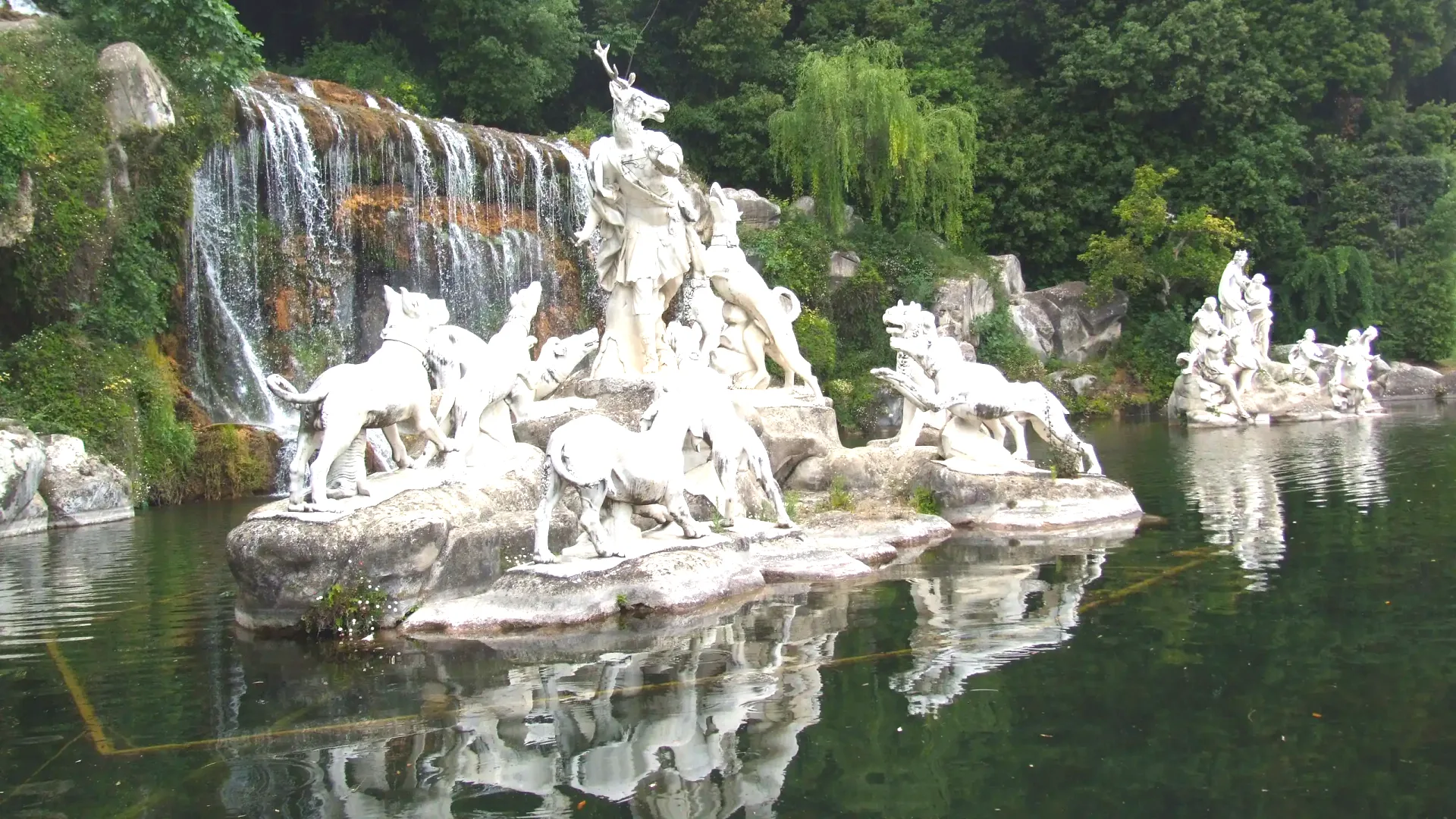
When the cascade is running — typically Tuesday through Sunday from spring through late autumn — the sequence of fountain basins along the central axis becomes a chase for children. Each basin has its own sculptural programme and its own water display: Margherita, Eolo, Cerere, Venere e Adone, and the climactic Diana e Atteone at the top, where a sculptural tableau shows the goddess Diana surprising the hunter Actaeon at a forest pool. Kids respond to the cascade for the obvious reasons — moving water, large sculptures, the chance to run between them — and parents respond to it because it gives the visit a clear narrative arc with a destination at the top.
Plan the cascade portion of the visit for the morning, when the water is reliably running and before the midday heat builds along the open axis in summer. Bring water bottles; the park has drinking fountains at intervals but they are not always working. Sun hats and sunscreen are essential from May through September. If the cascade is dry on the day you visit — Mondays, winter, or a maintenance day — most of the fountain magic is lost; check the fountain schedule before booking your day, and prefer Tuesdays through Fridays in May, June, September and October for the most reliable water.
The Diana e Atteone fountain at the top of the cascade rewards the climb. The sculptural group, executed in the late 18th century, shows Diana and her nymphs bathing as Actaeon stumbles upon them; in the myth he is turned into a stag and torn apart by his own hounds. Children respond to the drama of the figures even without knowing the story. The upper terraces also have benches and shade trees, making this a natural picnic spot.
The English Garden — Grottoes, Ruins and Hidden Discoveries
Branching east from the upper cascade, the English Garden — commissioned by Queen Maria Carolina in 1782 and designed by Sir John Graefer — is the most underrated part of a Caserta family visit. Unlike the formal French-style gardens of the central axis, the English Garden is a romantic landscape garden with winding paths, exotic plantings, a small lake, a grotto, and — the feature that delights every child who finds it — a set of deliberately picturesque artificial ruins, designed to look ancient. Built in the 1780s to evoke a romantic vision of antiquity, they are convincing enough that under-tens reliably believe they have discovered a real Roman site within the gardens.
Allow at least an hour for the English Garden if your visit allows. The path network is winding by design, so the experience is one of discovery rather than processional movement; this suits children's curiosity perfectly. The grotto has a cave-like atmosphere that holds attention; the camellia plantings — among the first introduced to continental Europe — flower spectacularly in late winter and early spring; and the lake is home to ducks and occasional herons. The English Garden is generally less crowded than the central axis even on busy days, because most visitors stop at the cascade and turn back.
Within the wider park, the Castelluccio is a small castellated folly built in the 18th century for the entertainment of the royal children — a miniature castle within the park, with a small moat and crenellations. It is not always open to interior access, but as an exterior feature it functions exactly as intended: a backdrop for imaginative play. Ask at the entrance whether the Castelluccio is accessible on your visit day.
Practical Kid Logistics — Shade, Toilets, Picnic Spots, Strollers
Shade along the central axis is intermittent; the design intentionally favours open perspective over tree cover. Plan for sun protection from May through September, and consider scheduling the cascade portion of the visit for mid-morning, when the sun is still angled and the heat manageable. The English Garden is far better shaded — its tree canopy and winding paths offer relief on hot days, and many families find it a natural retreat from the open cascade after lunch. Drinking water fountains exist along the park paths but not all are operational; carry your own water, especially in summer.
Public toilets are located near the palace entrance and at one or two points along the park; ask for the nearest at the ticket office on arrival. The palace itself has toilets at the ground-floor level near the cloakroom. Picnicking is permitted in the park's open lawns and is a beloved local Sunday tradition — Italian families lay out hampers on Pasquetta and Ferragosto in particular. The lawns around the lower basins and the upper Diana e Atteone area are the most popular picnic spots. There is no formal restaurant inside the palace itself, but cafes and snack kiosks operate in season near the entrance and at the upper cascade.
Stroller terrain is mixed. The asphalted cascade-side paths are good; the cobbled palace forecourt is bumpy; some English Garden paths are gravel or compacted earth that suits sturdy all-terrain pushchairs better than urban prams. The Royal Apartments are wheelchair- and stroller-accessible via lifts from the ground-floor entrance, with most rooms reachable on the piano nobile level. The Scalone d'Onore is the principal step-heavy feature, but lift access bypasses it. Baby-change facilities exist near the palace toilets; for park-side changes, a folded changing mat on a bench is the practical solution.
Star Wars, the Apartments, and Keeping Kids Engaged Indoors
The Royal Apartments are the part of a Caserta visit most likely to lose a young child's attention — long enfilades, painted ceilings and historic furniture are not natural kid material. The Star Wars connection is the lever that often works: the Throne Room and adjacent halls stood in for the palace of Naboo in The Phantom Menace and Attack of the Clones, and a child who has seen the films will recognise specific rooms. The Scalone d'Onore — the Grand Staircase — appears in transit shots and is genuinely spectacular at any age. Frame the apartment route as 'finding the Naboo rooms' for film-aware children, and the hour-and-a-half walk through becomes a game rather than a slog.
Pace the indoor portion realistically. Most under-tens are good for about an hour inside before energy flags. Consider doing the gardens first — bicycle, cascade, English Garden, picnic lunch — and saving the apartments for the early afternoon when the heat outside is at its worst and the cooler interior is welcome. A single circuit of the Scalone, State Apartments, Throne Room and King's Bedroom hits the highlights without overstaying. The Court Theatre, if open, is a small surprising room that often holds children's attention because of its scale and the visible stage. The Picture Gallery and deeper Queen's Apartments can be left for a return visit or skipped entirely with young families.
Frequently asked
Is the Reggia di Caserta really walkable for children?
The park is too long for under-tens to walk comfortably end-to-end — the cascade runs three kilometres from the palace forecourt to Diana e Atteone, with little shade on the central axis. Bicycle hire inside the park, available near the palace end, is the single best solution and turns an exhausting walk into a fun two-to-three-hour ride. The Royal Apartments are walkable with stroller access via lifts.
Can I hire bicycles inside the park?
Yes. Hire points operate inside the gardens, near the palace end of the park, with adult bikes, child bikes, child seats, tandems, and on most days e-bikes available. Helmets are typically provided. On busy days — Pasquetta, Ferragosto, the first Sunday of each month — the fleet sells out by mid-morning; arrive early or pre-reserve where possible.
Are strollers allowed in the park and palace?
Yes. Strollers are permitted in both the park and the Royal Apartments. The asphalted cascade paths are easy stroller terrain; the cobbled palace forecourt and some English Garden paths are bumpier and suit all-terrain pushchairs better than urban prams. The apartments are stroller- and wheelchair-accessible via lifts from the ground floor.
Where can we picnic inside the park?
Picnicking is permitted on the open lawns along the central axis and around the upper Diana e Atteone basins. The lawns near the lower basins are also popular. Italian families treat the park as the regional Sunday picnic ground when weather permits, particularly on Pasquetta and Ferragosto. There is no formal restaurant inside the palace itself; cafes and snack kiosks operate seasonally near the entrance and at the upper cascade.
Will my kids enjoy the Royal Apartments?
Some will, some won't. The Star Wars connection — the Throne Room and adjacent halls stood in for the palace of Naboo in Episodes I and II — is the lever that often works for screen-aware children. Frame the apartment walk as 'finding the Naboo rooms' and many under-tens engage with the route. Plan about an hour inside before energy flags, and prioritise the Scalone d'Onore, the Throne Room, the King's Bedroom and (if open) the Court Theatre.
Are the ruins in the English Garden real?
No. The picturesque ruins in the English Garden were built in the 1780s as deliberate fakes, designed to evoke a romantic vision of antiquity for the royal family. They are convincing enough that most children under ten believe they have discovered a real ancient site, which is exactly what their 18th-century designers intended. They are one of the highlights of a family visit.
What is the Castelluccio?
A small castellated folly within the park, built in the 18th century for the entertainment of the royal children. It functions as a miniature castle with a small moat and crenellations, set within the wider gardens. Interior access varies; as an exterior feature it works exactly as intended — a backdrop for imaginative play. Ask at the entrance whether it is accessible on your visit day.
Are there toilets and baby-change facilities?
Yes. Public toilets are located near the palace entrance and at one or two points along the park; the palace itself has toilets on the ground-floor level near the cloakroom. Baby-change facilities exist near the palace toilets. Along the park, a folded changing mat on a bench is the practical solution for outdoor changes.
What's the best age for a Caserta visit?
Children from about five upwards engage well with the cascade, the bicycle ride and the English Garden ruins. Under-fives can have a perfectly good day too — the bicycle child-seats and strollers make the logistics easy — but the apartments will hold less of their attention. Teenagers respond strongly to the Star Wars connection and to the architectural scale; the Court Theatre and the Picture Gallery reward older interest.
When is the cascade running and what if it isn't?
The cascade operates seasonally — broadly mid-March through late October — and only Tuesday through Sunday. It does not run in winter, and does not run on Mondays when the palace itself is closed. If you visit on a dry-cascade day, much of the kid-magic of the central axis is lost; the English Garden, the bicycle ride and the Royal Apartments still deliver, but the iconic running-fountain experience is gone. Check the schedule on reggiadicaserta.cultura.gov.it before booking your visit day.