 Skip-the-line available
 The Caserta Water Features — How Vanvitelli Made It Work
The fountains, the cascade, the Carolino aqueduct that feeds them — how 18th-century engineering still moves water through the gardens today.
The Reggia di Caserta's gardens require an enormous flow of water — for the cascading fountains, the central canal, the parterre planting, and especially the Diana and Actaeon waterfall at the gardens' far end. Vanvitelli designed a 38 km Roman-style aqueduct (the Carolino Aqueduct) specifically to supply the palace, completed in 1762. The infrastructure is part of the UNESCO inscription and the largest 18th-century engineering work in Italy.
The Carolino Aqueduct
The Carolino Aqueduct (Acquedotto Carolino) runs 38 km from the Fizzo springs near Bucciano (in the foothills of the Apennines) to Caserta. Built 1753-1762 to Vanvitelli's design, following Roman engineering models — most of the route is underground, but where the aqueduct crosses valleys it rises on stone arched bridges. The most famous section is the Ponti della Valle, a three-tier arched bridge over the Maddaloni valley — 529 metres long, 56 metres tall.
The Ponti della Valle bridge is itself a UNESCO-listed monument and one of the most-photographed engineering structures in southern Italy. It is visible from the A1 motorway south of Naples. Visitors interested in 18th-century engineering can detour to the bridge — 20 minutes' drive from Caserta. The aqueduct still functions; water flows continuously to the palace gardens.
The fountains and the cascade
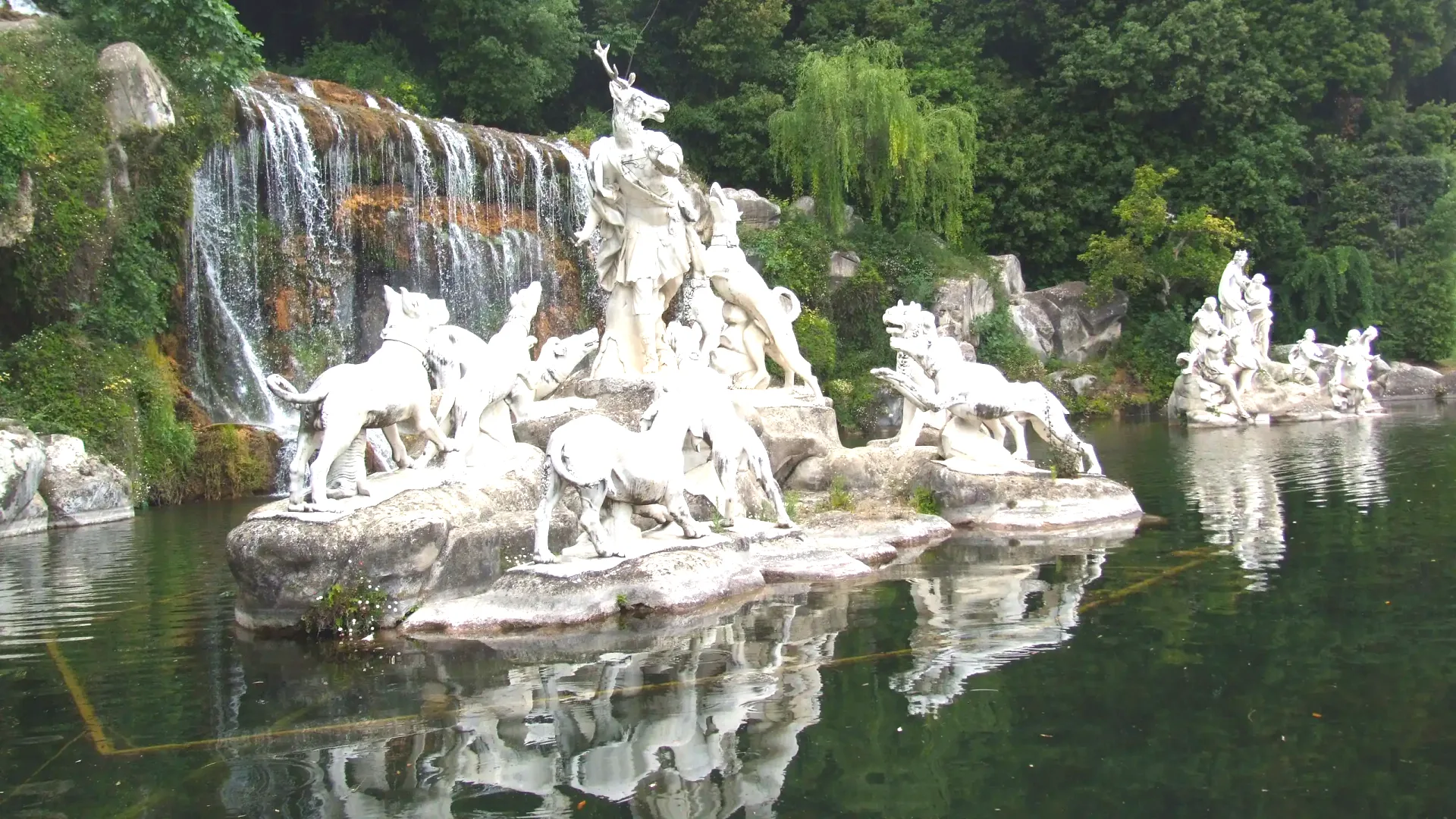
The Diana and Actaeon Fountain — the famous waterfall at the gardens' far end — is the dramatic climax of the water programme. Water cascades 50 metres down a deliberately constructed rocky hillside, fed by the aqueduct's final delivery point. The fountain itself depicts the Greek myth of Actaeon being turned into a stag by the goddess Diana — sculpted by Paolo Persico and others in the 1780s.
Other major fountains along the 3-km garden axis: Fountain of Aeolus (god of winds, with stone clouds and zephyrs), Fountain of Ceres (goddess of agriculture), Fountain of Venus and Adonis (the most-photographed mid-garden fountain). Each fountain is a Bourbon-era sculptural composition with mythological iconography. Most run during peak hours (10:00-17:00) but some operate on rotating schedules.
How the system still works
The water reaches the gardens by gravity flow — the aqueduct's slope is calculated to deliver water at the right pressure for each fountain. No pumps were used in the original design and none are needed today. The system has been in continuous operation since 1762, with periodic maintenance and 19th-20th-century repairs. Some fountains have been restored multiple times.
The 18th-century water infrastructure is invisible to most visitors — you see the fountains but not the aqueduct that feeds them. The water emerges at the top of the Diana and Actaeon waterfall, having travelled 38 km from the Apennine springs. This kind of large-scale hydraulic engineering was the technological pinnacle of 18th-century Europe and one of Vanvitelli's most significant achievements.
Frequently asked
How long is the Vanvitelli Aqueduct that feeds Caserta?
38 km, from the Fizzo springs near Bucciano to the Caserta gardens. Most of the route is underground, but the aqueduct rises on stone arched bridges where it crosses valleys — most famously the Ponti della Valle bridge over the Maddaloni valley (529 metres long, 56 metres tall).
Was the aqueduct part of the original design?
Yes — Vanvitelli designed the aqueduct specifically to feed the Caserta gardens, starting construction in 1753. The aqueduct was completed in 1762, before the palace itself was finished. The water infrastructure was as much a part of the design as the palace and gardens.
Does the aqueduct still work?
Yes — water still flows from the Fizzo springs to the Caserta gardens by gravity, 263 years after its construction. The system has had periodic maintenance and repairs but the basic 18th-century engineering still functions. The Diana and Actaeon waterfall runs continuously.
Can I visit the Ponti della Valle bridge?
Yes — the bridge is publicly accessible, 20 minutes' drive from Caserta (in the town of Valle di Maddaloni). It is visible from the A1 motorway south of Naples. The bridge is itself a UNESCO-listed monument.
How tall is the Diana and Actaeon waterfall?
50 metres — the artificial cascade drops 50 metres down a deliberately constructed rocky hillside at the south end of the gardens. The Diana and Actaeon sculptural composition at the base depicts the Greek myth of Actaeon turned into a stag.
Who designed the Caserta fountains?
Architect Luigi Vanvitelli designed the overall water programme and the major fountain structures. The sculptural compositions on individual fountains were by various 18th-century Italian sculptors — Paolo Persico (Diana and Actaeon), Pietro Solari (other major works). Vanvitelli's son Carlo took over after Luigi's death in 1773.